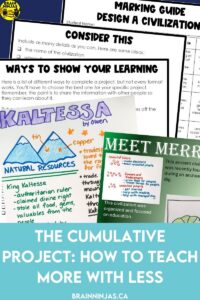
Here’s something nobody tells you about cumulative projects: they’re one of the best-kept time-management secrets in teaching.
Most teachers we know are running on fumes by mid-year. You’re teaching five different things at once, managing behaviour, writing report cards, and trying to stay on pace with curriculum. The idea of adding a “big project” to that sounds like adding another log to an already-burning fire.
But what if we told you a well-designed cumulative project could reduce your workload while actually increasing what students learn? We know that sounds like teacher-blog fantasy. But we’ve seen it work. We’ve lived it. And we want to walk you through exactly how to teach more with less.
What’s a Cumulative Project (And Why It’s Different)?
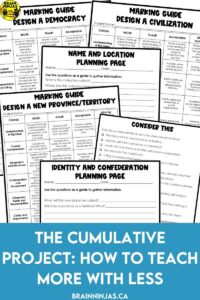
A cumulative project is a single, substantial assignment that students work on over several weeks, adding layers and complexity as they learn new concepts.
It’s not a “do this worksheet, now do this worksheet, now do that worksheet, then put it all together.” It’s more like: students are building one thing across the entire unit, and as they learn new concepts, they integrate them into what they’re already creating.
Example: Students design a government system. Most social studies curricula across Canada cover government and democracy at some point, so this works in most Canadian classrooms.
- Week 1: They research how governments make decisions, then sketch their government structure.
- Week 2: They learn about representation and voting, then revise their structure to include these elements.
- Week 3: They study rights and responsibilities, then add a charter/rights document to their project.
- Week 4: They present their complete system.
By the end, they’ve learned about government structure, representation, voting, and rights. They’ve practiced historical thinking. And they’ve only “submitted” one project.
Why This Actually Saves You Time
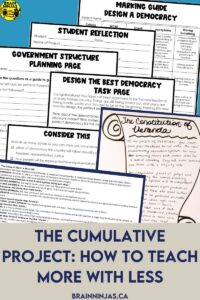
We know what you’re thinking: How does one big project save time when I’m used to multiple smaller assignments?
Math: Instead of assigning five separate worksheets + a test + a project, you’re assigning one project with built-in checkpoints.
Quality: With fewer assignments, you can actually assess thinking instead of just checking completion. You see how students are really understanding the material.
Pacing: One continuous thread through a unit is easier to manage than trying to keep students on pace with five different activities.
Marking: You’re assessing one piece of work that evolves over time, not dozens of separate items. Your report card evidence is actually strong because you’re watching students apply concepts in increasingly complex ways.
Behaviour: Students stay more engaged because they’re working toward something concrete and visible, not just doing random tasks.
The Secret: Planning Pages That Actually Work
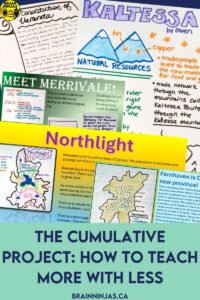
The difference between a project that saves time and one that creates chaos? Hint: It’s the planning pages.
Planning pages serve two critical functions:
1. They scaffold research for students: Instead of “go research civilizations,” you give students targeted questions: Where would your civilization settle? Why? What does the land provide? What challenges would it face? This prevents students from getting lost on Google, Wikipedia rabbitholes or submitting vague information they’ve regurgitated from an AI summary. You get usable research that actually feeds into their project.
2. They create checkpoints for you Instead of finding out Week Four that half your class doesn’t understand the concept, you’re checking Week One planning pages. If someone hasn’t grasped the idea, you catch it early.
These checkpoints take fifteen minutes to scan, not forty-five minutes to deeply mark. But they keep everything on track.
How to Build a Cumulative Project (Fast)
If you’re thinking about creating one, here’s the streamlined version:
Step 1: Start with the end. What will students create? Be specific. (Not “a project about civilizations” but “a illustrated guide to their own designed civilization that explains geography, government, economy, and culture.”)
Step 2: Work backward through your curricular outcomes. What do students need to understand to create that thing? That’s your unit content.
Step 3: Create 3-4 planning pages that guide research for each concept. Make them scaffolded but open-ended enough for different learners.
Step 4: Plan presentation options. Poster? Written document? Digital presentation? Diorama? Let students choose format but keep the content consistent.
Step 5: Build one clear rubric. One. Not five rubrics. One that shows what “great” looks like at each level. Focus on the content-not the project. If you are assessing understanding of content, leave out the spelling conventions.
Step 6: Create checkpoints. Week One: submit planning page. Week Two: submit research. Week Three: check-in on progress. Week Four: presentation.
That’s it. That’s your unit structure (and of course this is just an outline). Your project and timeline will shift based on the content you’ll teach, your students and your classroom needs.
The Differentiation Happens Automatically
Here’s something beautiful about cumulative projects: differentiation built in.
A student who struggles with writing can create a visual-heavy poster. A student who loves detail can write comprehensive descriptions. A student who’s advanced can add extra complexity to their system. Everyone’s still learning the same big ideas, but they’re expressing understanding differently.
You don’t need five different versions of the project. The project itself is flexible enough to meet different learners where they are.
Real Talk: When Cumulative Projects Work Best
They’re not perfect for every unit, so let me be honest about when to use them:
Cumulative projects shine when:
- The unit has multiple interconnected concepts (civilizations, government systems, communities).
- Students have time to work over several weeks.
- You want to assess thinking, not just recall.
- Your class can handle some autonomy. This can be taught, but needs to be scaffolded as your students learn to work more independently. This post can help with building autonomy: How to Accidentally Teach Helplessness to Students.
They’re less ideal when:
- You’re teaching discrete facts that don’t build on each other.
- You have limited class time.
- You’re introducing a completely new concept (maybe pair it with more direct teaching first).
- Your students have no ability to work independently. But remember, you can still use projects for those students who can and do smaller group work to guide the ones that can’t.
Most Grade 3-6 social studies units? Perfect for cumulative projects. You’ve got interconnected big ideas, you’ve got time, and students learn way better this way.
The Projects That Do This Work
We’re not going to pretend you need to build this from scratch. We spent weeks designing cumulative projects specifically for social studies curricula.
Three projects we’ve created are designed specifically around this principle:
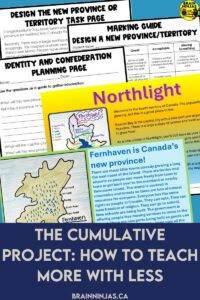
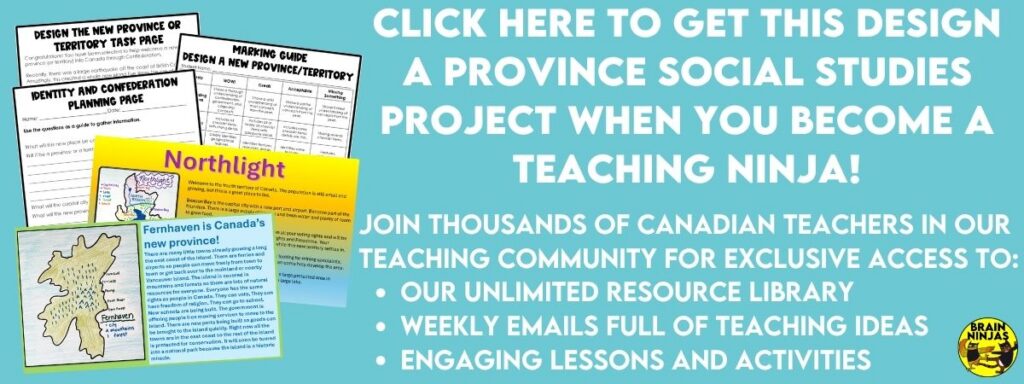
- Design a Province (or Territory): Students create a new province (or territory) that is entering Confederation. They will explain the natural resources, regions, geographical features and so much more. This works for any grade learning about regions, natural resources or Confederation.
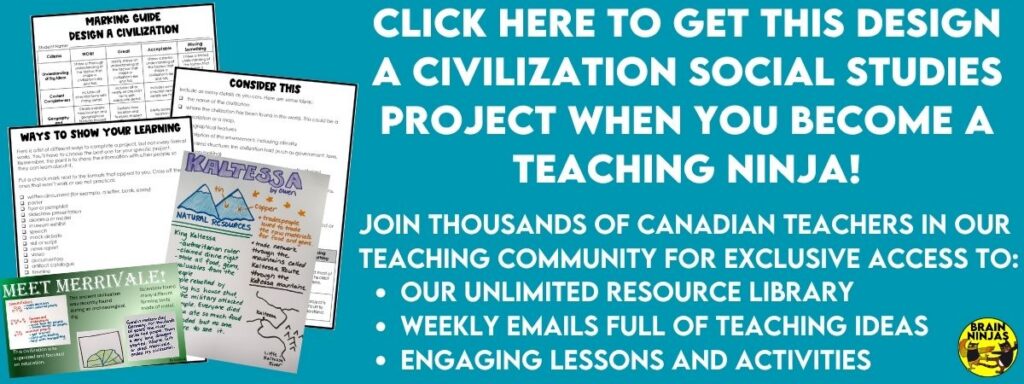
- Design a Civilization: Students create an entire civilization by researching and deciding on geography, resources, economy, government, and society. Comes with all planning pages, scaffolding, and rubrics. This works for any grade learning about ancient civilizations.
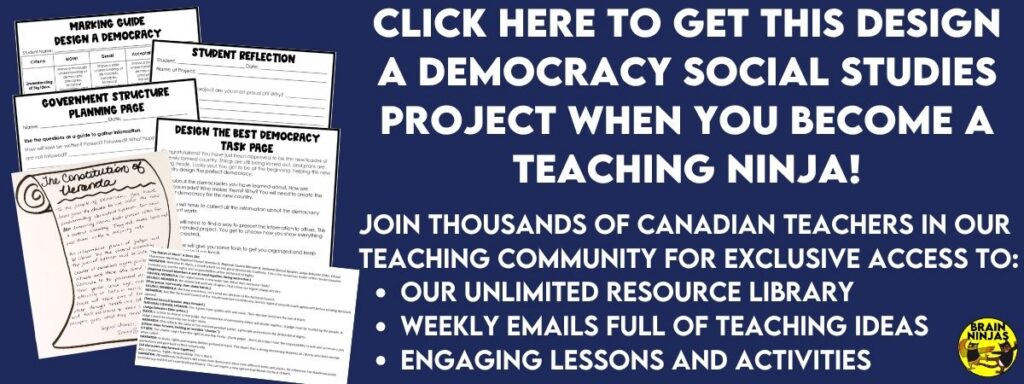
- Design a Democracy: Students design a complete government system from scratch by learning about foundational principles, representation, voting, justice, and rights. This works for any grade learning about govenment or democracy.
The projects include:
- Guided planning pages for each concept
- Multiple presentation format options
- Complete marking rubrics
- Reflection pages for assessment
- Learning goals
Make This Work in Your Classroom
Start small. Pick one unit this year. Commit to the cumulative project approach.
You’ll spend a few hours upfront designing the project and planning pages. But you’ll save hours during the unit because students stay focused, assessment is streamlined, and you’re not managing five different assignments.
More importantly, your students will understand the content deeper because they’re applying it in real time, not just answering questions about it.
That’s the real payoff of cumulative projects: less stuff to manage, more actual learning happening.
If you need help finding resources for the new Alberta Social Studies Curriculum, we’ve already done all the work for you.
Grade 3 Alberta Social Studies Full Year of Lessons in our TpT Store ($USD) or our BN Shop ($CAN).
Grade 4 Alberta Social Studies Full Year Lessons in our TpT Store ($USD) or our BN Shop ($CAN).
Grade 5 Alberta Social Studies Full Year Lessons in our TpT Store ($USD) or our BN Shop ($CAN).
Grade 6 Alberta Social Studies Full Year Lessons in our TpT Store ($USD) or our BN Shop ($CAN).



Leave a Reply