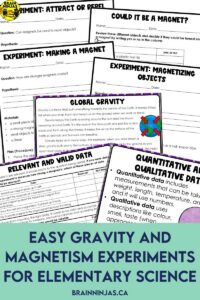
Remember that moment when a student’s eyes light up during science class? When they gasp at a discovery or run to tell their classmate what they just observed? That’s the magic we’re all chasing. But here’s the honest truth: not every lesson lands that way. It’s not because we’re not trying hard enough. Often, it’s because our students need hands-on experiments paired with clear, structured guidance to really get it.
The good news? Gravity and magnetism are two of the most exciting forces to explore in elementary science. They’re perfect for bringing that spark back into your classroom.The magic is the in the planning and the good news is that we’ve already planned it for you.
Why Gravity and Magnetism Matter (Beyond the Textbook)
Gravity and magnetism are invisible forces that students see in action every single day. A dropped pencil. A magnet on the fridge. A ball rolling downhill. These forces are everywhere, and yet they often feel mysterious or abstract to students.
When we give students time to experiment, predict, and observe these invisible forces in real life, something clicks. They stop seeing science as “something in a book” and start seeing it as the way the world actually works. That engagement and curiosity is what sticks with them long after the lesson ends.
But here’s the challenge: hands-on experiments are only half the battle. Our students also need to learn how to do science. They need to understand that it’s not just that science is cool.
The Missing Piece: Teaching the Scientific Method Alongside Experiments
Have you noticed something about science lessons that include experiments? Sometimes students do the activity, observe the results, and then… we move on. They had fun, sure. But did they learn the process that all scientists actually use?
The scientific method is the framework that turns a fun activity into real scientific thinking. When students learn to ask questions, make predictions, follow procedures, record observations, and draw conclusions, they’re not just doing an experiment. Your students are thinking like scientists.
Here’s the thing: teaching the scientific method doesn’t have to be complicated. When you connect it directly to the experiments your students are doing, it becomes practical and real instead of abstract.
Our Free Resource to Help You Get Started
Before we dive into the specific experiments in our gravity and magnetism resource, we want to help you feel confident teaching the scientific method itself.
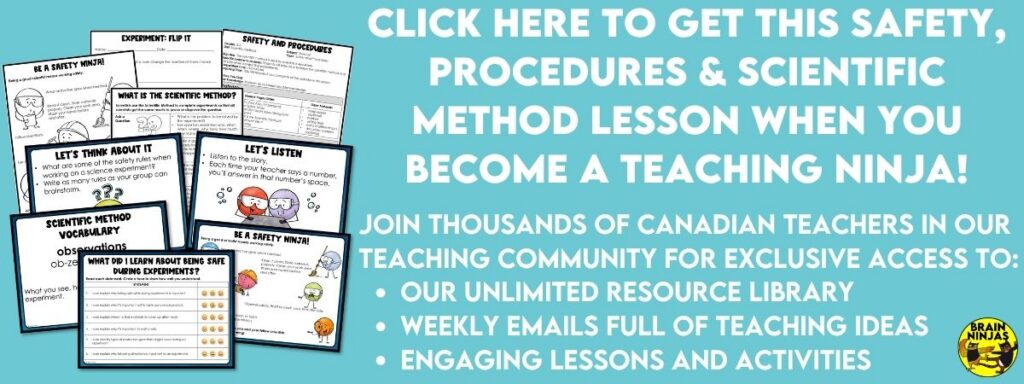
Become a ninja: Get a free scientific method lesson when you subscribe (plus access to our Resource Library and exclusive teaching resources). This lesson breaks down each step of the scientific method in kid-friendly language and includes guided activities your students can use right away. It’s designed to work alongside any experiment you’re doing in your classroom.
Once you have this foundation in place, your students will be ready to approach experiments with real scientific thinking.
What’s Inside: A Complete Gravity and Magnetism Resource
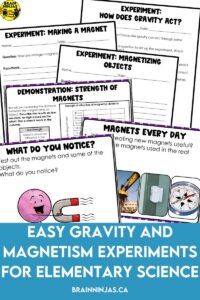
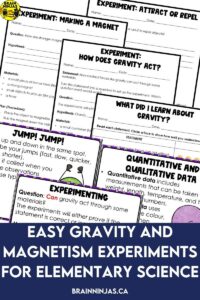
Our Gravity & Magnetism: Safety and Scientific Method Lesson is built on one core idea: hands-on learning works best when students understand how to experiment. You can find it in our TpT Store ($USD) or our BN Shop ($CAN).
Our engaging resource includes:
Guided Lessons on Safety and the Scientific Method
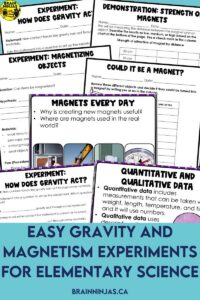
We start with safety because good scientists work responsibly. Then we walk students through the scientific method step by step, using experiments about gravity and magnetism to show them what each step looks like in practice. Our experiment templates make being consistent easy.
Hands-On Experiments Students Will Love
Your students will flip coins to test gravity. They’ll investigate how different soaps create different-sized bubbles. They’ll record observations, make predictions, and discover real patterns in how gravity and magnetism work.
Flexible Delivery Options
Whether your classroom is fully digital, completely paper-based, or somewhere in between, this resource works for you however you need it. You can use it with teacher slides, student slides, or printed paper copies. The flexibility means you can teach the way your students learn best. And, since we don’t control the internet, we’ve made it possible to teach completely without technology.
Differentiation Built In
Upper elementary classrooms are wonderfully diverse (that wasn’t intended as sarcasm). Some students need more support with reading and writing, while others are ready for deeper thinking. Our resource includes variations that meet students where they are. We include vocabulary supports in our unit and year plans.
Try These Bonus Experiments
Beyond what’s included in the resource, here are two experiments that bring gravity and magnetism to life in the most engaging ways:
Paper Airplane Design Challenge (Gravity)
Give students several different paper airplane designs and ask them to predict which one will fly the farthest. Why? Because shape and design affect how gravity pulls on the plane. Students can build planes, test them, compare results, and explain why they think different designs fly differently. It’s a perfect real-world example of how gravity doesn’t pull all objects down the same way. Air resistance and design matter.
Floating Magnet Column (Magnetism)
This is pure magic in a science lesson. Stack ring magnets around a pencil or marker, but orient them so the same poles face each other. The magnets will levitate without touching. Students are mesmerized watching gravity pull down while magnetic repulsion pushes up. It’s the perfect visual for understanding that multiple forces can act on an object at the same time.
Ready to Teach Science Your Students Will Remember?
The experiments are just the beginning. When you pair hands-on exploration with explicit teaching of the scientific method, your students become real thinkers, not just observers.
Gravity & Magnetism: Safety and Scientific Method Lesson gives you everything you need. The lesson plans are detailed but not overwhelming. The activities are engaging but not complicated to set up. And the flexibility means you can use it in any classroom. Your students deserve science lessons that make them feel like real scientists. This resource does exactly that. Get your copy today: You can find it in our TpT Store ($USD) or our BN Shop ($CAN). If you are a teacher in ALberta, you might find more resources to round out your year here.
And don’t forget to grab your free scientific method lesson. You also get access to our full Resource Library filled with classroom-ready materials.
Your next amazing science lesson is just a few clicks away.



Leave a Reply