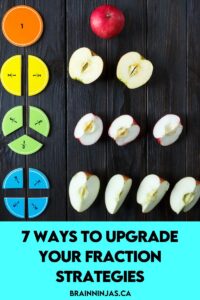
Fractions can be a struggle for many students, but it really comes down to understanding them visually. Before we ever teach students the numerals or symbols, we try to show them the meaning of fractions visually in a variety of ways so they can truly understand parts, sets, and wholes. If you’ve ever struggled to teach fractions to your students, this is probably the post for you. Come try these fraction strategies that work for wide range of learners.
How do you teach fractions?
We start with hands-on and visual examples. Then we move to manipulatives like fraction towers and circles. Once students can show concrete examples of fractions, we start using notation and symbols.
Show Students Real Examples of Fractions in the World
Give your students a handful of a similar type of candy. If you don’t have candy, use pieces like centimetre cubes or bingo counters (you’ll need multiple colours). Ask them to sort the pieces into different colours. Talk about the total number of pieces and describe it as the whole group of candies. Then talk about one of the colours. This is part of the whole.
If you have access to a chocolate bar that has squares, show the whole and the part. This is a great reason to bring in a Caramilk bar.
Show students that recipes always include fractions. Use a measuring cup and talk about the different fractions found in a recipe.
Explain that the coins all use fractions of dollars. Ten dimes is a dollar. That means one dime is 1/10. Have students work out the other fractions with the rest of the coins.
Use Lego
Ninjas never pass up an opportunity to use Lego in a lesson. Grab a 2×4 brick. There are eight studs across the top. This is the whole. Use a 1×2 brick and place it on top. It uses two of the studs. The smaller brick is 2/8 of the larger brick. If your students are also doing equivalent fractions, show students that it is also one quarter or 1/4.
Use Fraction Tower Cubes
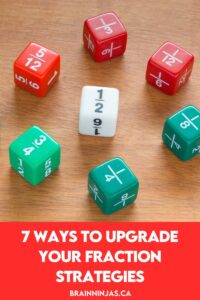
Fraction Tower Cubes work wonders for helping students compare fractions or see them visually. Our link is not an affiliate link, and you should be able to find them at most educational stores. If your school cannot afford a class set, you can get a magnetic set that goes on your whiteboard (or you can use it under the document camera). If you search for ‘Rainbow Fraction Tiles,’ you’ll also find similar types of strips of fractions, so compare them side by side.
Use Fraction Circles
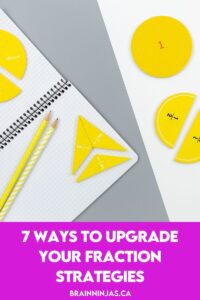
Fraction Circles are similar to tower cubes, but you can see them as part of a whole circle. Our link is not an affiliate link, and you should be able to find them at most educational stores.
Teach Fraction Strategies
Once students have a visual understanding of fractions, they are ready for explicit instruction. Our interactive math units come with complete lesson plans, student templates (with and without cutting and pasting), worksheets, practice activities, games, assessments, and guides for Alberta, British Columbia, and Saskatchewan curriculums. We’ve tried to put everything together in one place so you can focus and just teach your lessons.
- Number Concepts (Fractions Included) Interactive Math Unit for Grade 3 Find it on TpT ($USD) or our BN Shop ($CAD).
- Decimals and Fractions Interactive Math Unit for Grade 4. You can find it on TpT ($USD) or our BN Shop ($CAD).
- Decimals and Fractions Interactive Math Unit for Grade 4/5 Find it on TpT ($USD) or our BN Shop ($CAD).
- Decimals and Fractions Interactive Math Unit for Grade 5. It is available on TpT ($USD) or our BN Shop ($CAD).
- Decimals, Fractions, Ratios, Percent Interactive Math Unit for Grade 5/6 Find it on TpT ($USD) or our BN Shop ($CAD).
- Decimals, Ratios, Fractions, Percent Interactive Math Unit for Grade 6 Find it on TpT ($USD) or our BN Shop ($CAD).
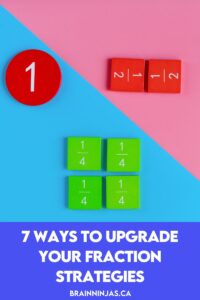
We always start by introducing the concept of fractions. We stick to proper fractions at first and teach students to understand the meaning of wholes and sets or parts of sets. Students can compare fractions with the same denominator. Once students are confident with understanding fractions, we move into equivalent fractions and work with different denominators. From there, we relate them to decimals. When students understand equivalent fractions, they can compare fractions with unlike denominators.
From there, students can begin operations with fractions.
Practice Fraction Strategies With Task Cards
Task cards are a great way to practice specific fraction skills. We have lots of different sets of cards available. To learn more about how we use task cards in our classroom, read The Trouble With Task Cards and How to Fix It. Each set of our task card sets comes with a paper set, a Google Slides version, and a self-marking Google Forms version. All of our task card sets come with three different decks of cards, each with twenty-four questions.
This set is a bit simpler:
- Representing Simple Fractions Find them on TpT ($USD) or our BN Shop ($CAD).
These sets are a bit more complex or difficult:
- Representing Fractions Within One Find them on TpT ($USD) or our BN Shop ($CAD).
- Converting Fractions & Decimals Find them on TpT ($USD) or our BN Shop ($CAD).
- Ordering and Comparing Fractions Find them on TpT ($USD) or our BN Shop ($CAD).
Practice Fraction Strategies With Worksheets
Worksheets are one way to practice working on specific skills. While we don’t use worksheets on a regular basis, there is a purpose to using them in your classroom. If you have lots of worksheets, try some of the strategies in our post Math Worksheet Games Your Students Will Love.
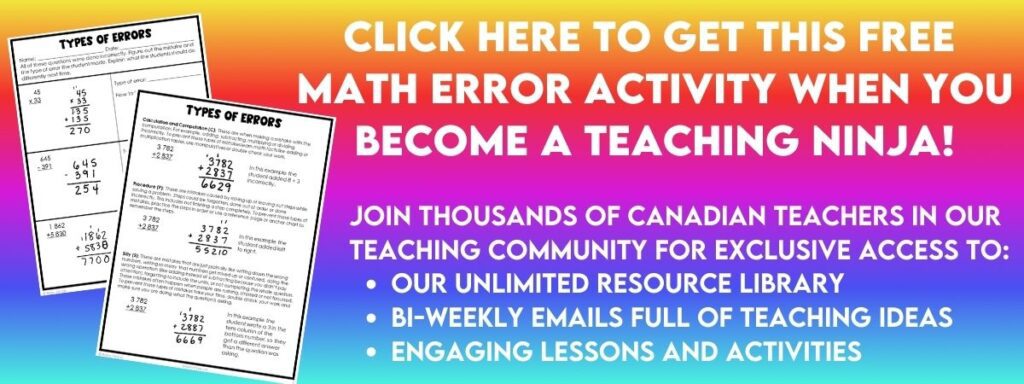
One of the strategies we use with worksheets is to have students correct our errors. We use this simple free resource to teach students about the different types of math errors. If you are already on our email list, you can find this Error Analysis Activity in our Resource Library. If you would like it sent directly to your inbox, you can sign up for our email list.
Fractions Within One
We have several different types of fraction worksheets.
These sets are simpler:
- Representing Fractions Worksheets: Find them on TpT ($USD) or our BN Shop ($CAD).
- Comparing and Ordering Fractions With Common Denominators Worksheets: Find them on TpT ($USD) or our BN Shop ($CAD).
These sets are a little more difficult:
- Representing Fractions Within One Worksheets: Find them on TpT ($USD) or our BN Shop ($CAD).
- Representing Proper Fractions Worksheets (Grade 5): Find them on TpT ($USD) or our BN Shop ($CAD).
- Simplifying Fractions Worksheets: Find them on TpT ($USD) or our BN Shop ($CAD).
- Comparing Fractions With Common Denominators Worksheets: Find them on TpT ($USD) or our BN Shop ($CAD).
- Comparing Fractions With Unlike Denominators. You can find them on TpT ($USD) or our BN Shop ($CAD).
- Converting Fractions and Decimals to Hundredths Worksheets: Find them on TpT ($USD) or our BN Shop ($CAD).
- Converting Fractions and Decimals to Thousandths Worksheets: Find them on TpT ($USD) or our BN Shop ($CAD).
- Equivalent Fractions Worksheets: Find them on TpT ($USD) or our BN Shop ($CAD).
Fractions More Than One
- Mixed & Improper Fractions Conversions Worksheets: Find them on TpT ($USD) or our BN Shop ($CAD).
- Comparing Mixed & Improper Fractions Worksheets: Find them on TpT ($USD) or our BN Shop ($CAD).
- Adding & Subtracting Mixed & Improper Fractions Worksheets: Find them on TpT ($USD) or our BN Shop ($CAD).
- Multiplying & Dividing Mixed & Improper Fractions Worksheets: Find them on TpT ($USD) or our BN Shop ($CAD).
Ratios and Percent
- Introduction to Ratios Worksheets: Find them on TpT ($USD) or our BN Shop ($CAD).
- Calculating and Representing Percent Worksheets: Find them on TpT ($USD) or our BN Shop ($CAD).
- Calculating Percent Worksheets: Find them on TpT ($USD) or our BN Shop ($CAD).
- Relating Ratios and Percent to Decimals and Fractions Worksheets: Find them on TpT ($USD) or our BN Shop ($CAD).
We also have bundles for each province containing worksheets that align with each province’s curriculum:
Alberta-Aligned:
- Grade 3 Number Concepts Worksheet Bundle: Find on TpT ($USD) or our BN Shop ($CAD)
- Grade 4 Decimals and Fractions Worksheet Bundle: Find on TpT ($USD) or our BN Shop ($CAD)
- Grade 5 Decimals and Fractions Worksheet Bundle: Find on TpT ($USD) or our BN Shop ($CAD)
- Grade 6 Decimals and Fractions Worksheet Bundle: Find on TpT ($USD) or our BN Shop ($CAD)
British Columbia-Aligned:
- Grade 3 Number Concepts Worksheet Bundle: Find on TpT ($USD) or our BN Shop ($CAD)
- Grade 4 Decimals and Fractions Worksheet Bundle: Find on TpT ($USD) or our BN Shop ($CAD)
- Grade 5 Decimals and Fractions Worksheet Bundle: Find on TpT ($USD) or our BN Shop ($CAD)
- Grade 6 Decimals and Fractions Worksheet Bundle: Find on TpT ($USD) or our BN Shop ($CAD)
Saskatchewan-Aligned:
- Grade 3 Number Concepts Worksheet Bundle: Find on TpT ($USD) or our BN Shop ($CAD)
- Grade 4 Decimals and Fractions Worksheet Bundle: Find on TpT ($USD) or our BN Shop ($CAD)
- Grade 5 Decimals and Fractions Worksheet Bundle: Find on TpT ($USD) or our BN Shop ($CAD)
- Grade 6 Decimals and Fractions Worksheet Bundle: Find on TpT ($USD) or our BN Shop ($CAD)
Fraction Strategies FAQ
How do you teach fractions to upper elementary students?
We start with the visual meaning of fractions before we introduce numerals or symbols. Students sort and describe real objects like candy, coins, and measuring cups, then work with Lego bricks, fraction tower cubes, and fraction circles to see parts, sets, and wholes. Once they understand the idea visually, we move into explicit instruction with notation, comparing, and equivalent fractions.
What hands-on materials work for teaching fractions?
We use candy, centimetre cubes, or bingo counters in several colours to show parts of a whole group. A chocolate bar with squares, measuring cups, and coins work well too. Fraction tower cubes and fraction circles help students compare fractions side by side. If a class set is out of budget, a magnetic set for the whiteboard or a set under the document camera does the job.
How can Lego bricks help students understand fractions?
Grab a 2×4 brick, which has eight studs across the top. That brick is the whole. A 1×2 brick placed on top covers two studs, so it is 2/8 of the larger brick. Students working on equivalent fractions can then see that 2/8 is the same as 1/4.
In what order should we teach fraction skills?
We start with proper fractions and the meaning of wholes and sets or parts of sets. Next, students compare fractions with the same denominator. Once they are confident, we move into equivalent fractions and different denominators, then relate fractions to decimals. When students understand equivalent fractions, they can compare fractions with unlike denominators. After that, they are ready to begin operations with fractions.
What fraction resources do you have for Canadian classrooms?
Our interactive math units for Grades 3-6 include lesson plans, student templates, worksheets, practice activities, games, and assessments, with guides for Alberta, British Columbia, and Saskatchewan. We also have fraction task cards in paper, Google Slides, and self-marking Google Forms versions, plus fraction worksheets and province-aligned worksheet bundles. Find them on TpT ($USD) or our BN Shop ($CAD).
Do You Teach Math?
You might find some of these posts helpful.
- How to Make Teaching Patterns Painless
- How to Teach Students to Tell Time
- How to Use Interactive Notebooks to Teach Number Sense
- Ways to Teach Shape and Space Concepts
- How to Teach Students to Analyze Errors in Math
- How to Help Your Students Master Decimal Operations
- Ways to Bring Graphing Activities into Your Classroom Daily
- How to Add Candy to Your Math Lessons
- How to Teach Successful Long Division Strategies
- Conquer Math With These Proven Multiplication Strategies
- How to Differentiate Your Math Lessons
- Amazing Measurement Activities to Stretch Math
- Ways to Teach Classifying Triangles
- How to Teach Rounding Numbers
How do you teach fraction strategies to your students? We’d love to hear more about it. Leave us a comment below.



