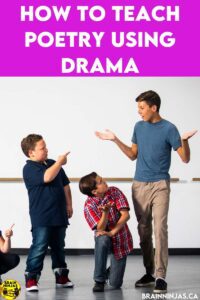
Poetry is a beautiful and expressive form of literature that often expresses emotions, paints vivid imagery, and can be fun to read and write. Learning about poetic elements and figurative language can be engaging and memorable by teaching poetry using drama.

We teach poetry throughout the school year rather than during a single unit. This means we have the chance to mix up how we approach teaching poetry. Our students tend to love drama activities because it gives them the chance to move and be creative in new ways. If you’re looking for more ways to teach poetry, check out our post How to Teach Poetry All Year Long.
Teach It
We created a whole resource to get you started teaching poetry using drama. The lesson plan includes poems and suggestions for actions, and will help explicitly teach students some of the basics. It includes figurative language and some different styles of poetry. Once you have the basics, you can challenge your students to express poetry using drama in lots of different ways. Find Poetry Using Drama Lesson in our TpT Store ($USD) or our BN Shop ($CAN).
Reader’s Theatre
Reader’s theatre is a form of drama in which students perform a script adapted from a written text. Teachers can select poems with rich imagery, vivid language, and distinct characters, and divide them into parts for students to perform. By assigning roles and encouraging students to embody the characters through voice, expression, and movement, teachers can deepen students’ understanding of poetic elements such as tone, mood, and characterization.
You don’t even need to have an official script. You can use any poem and just assign words or lines to students. If you need a place to start, try using call-and-response songs or nursery rhymes.
Poetry Performances
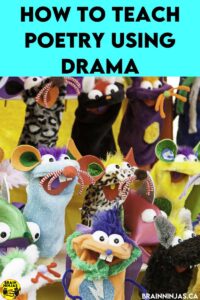
Organize poetry performances where students have the opportunity to recite or perform poems in front of their peers, families, or at school assemblies. Encourage students to use expressive reading techniques, such as varying their tone, pace, and volume, to convey the mood and meaning of the poem. This activity not only helps students develop confidence in public speaking but also allows them to appreciate the rhythmic and lyrical qualities of poetry.
If you’ve ever memorized In Flanders Fields, you’ve been part of a poetry performance. Choose a poem that is short, but can be easily memorized. If memorization isn’t required, allow students to make notes on their poem for actions and expressions.
Tableau
Use tableau, a dramatic technique where students freeze in poses to create a living picture, to represent key moments or themes in a poem. After reading a poem, have students work in groups to create tableaus that visually depict elements such as setting, characters, or emotions. Encourage students to use body language, facial expressions, and spatial relationships to convey the essence of the poem.
Dramatic Readings
Engage students in dramatic readings of poems by incorporating sound effects, music, and props to enhance the atmosphere and evoke emotions. Encourage students to experiment with different vocal techniques, such as whispering, shouting, or using accents, to emphasize the poetic elements of rhythm, rhyme, and repetition. This activity allows students to explore the auditory qualities of poetry and develop their interpretive skills.
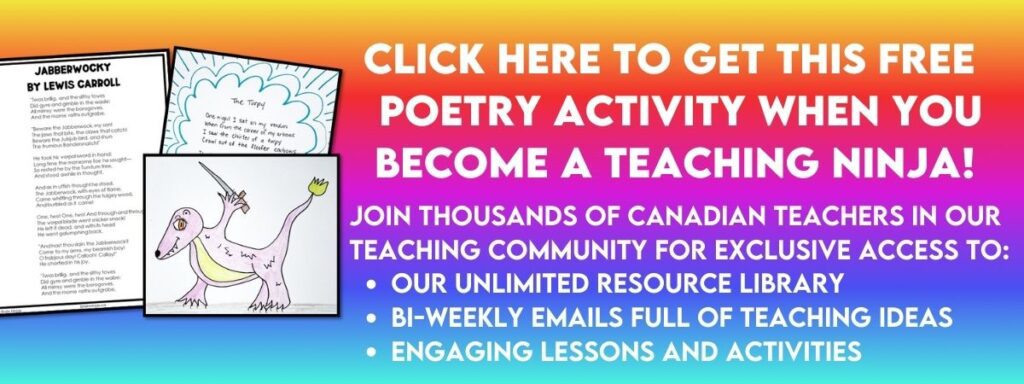
This activity can be even more fun using a poem with nonsense words. We created this simple poetry lesson featuring Lewis Carroll’s Jabberwocky. We can send the lesson directly to your inbox when you sign up for our email list. If you’re already on the list, find the lesson in our Resource Library.

Improvisation
Use improvisation exercises to encourage students to think creatively and spontaneously about the themes, characters, and settings of poems. Provide students with prompts or scenarios inspired by the poem and challenge them to improvise short scenes or monologues based on their interpretations. This activity fosters critical thinking, empathy, and collaboration as students explore different perspectives and emotions.
Poetry Slam
Organize a poetry slam where students write and perform their own original poems in a competitive and supportive environment. Encourage students to experiment with poetic elements such as imagery, metaphor, and symbolism in their writing and performance. This activity empowers students to express themselves authentically and encourages a deeper appreciation for the power of language and self-expression.
We taught our students to snap instead of clap, and they seemed to enjoy it. Our classroom was transformed into a cafe and students dressed up to perform.

Character Interviews
Invite students to imagine themselves as characters from a poem and conduct mock interviews where they respond to questions as their character. This activity encourages students to delve into the motivations, feelings, and experiences of the characters and helps them develop empathy and understanding of the poem’s themes and messages.
Poetic Dialogue
Encourage students to write dialogue between characters in a poem or between the poet and a character. Students can then perform the dialogue, bringing the characters to life and exploring their relationships, conflicts, and resolutions. This activity fosters creativity, interpretation, and collaboration as students engage with the poem’s content and context.
Do you teach Language Arts?
While teaching poetry is one aspect of teaching language arts, we have lots of other posts to help you out.
- Help! I Don’t Know How to Teach Reading
- Practical Strategies for Reluctant Readers
- Add Great Content to Your Literacy Lessons
- How to Celebrate Poem in Your Pocket Day
- How to Include Different Types of Writing in Your Classroom
How do you like to teach poetry in your classroom? We’d love to hear about it. Leave us a comment below.



