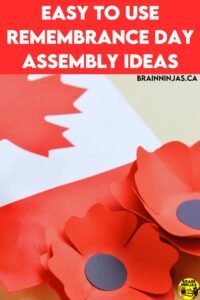
Every school across Canada has held a Remembrance Day assembly since the end of the Second World War. In fact, it is written into the School Act in Alberta as a requirement. Schools must have a Remembrance Day assembly on the day closest to November 11. We’ve got some Remembrance Day assembly ideas for you.
We’ve been thinking how we’ll honour our soldiers at school. If you are planning a Remembrance Day assembly, we might have a few ideas for you.
Remembrance Day Assemblies are Required
If you’re looking for more information on why we observe this day, read The Importance of Remembrance Day. If you’re looking for Remembrance Day assembly ideas, keep reading.
Sing the Anthem
One of our favourite versions of O Canada is played regularly in our school. It is performed by Asani and features English, French, and Cree. It is a unique version, so it’s best if your students are already familiar with it before using it as a ceremonial song. Our students love it.
If there are any other singing performances, these can be done in person or you can make recordings. Your recordings can be audio or video recordings and can be shared with your school staff in whichever way works best for your situation. Using recordings has the benefit of saving time with transitions, but there can be technical difficulties that can make things challenging.
Speakers Can Speak
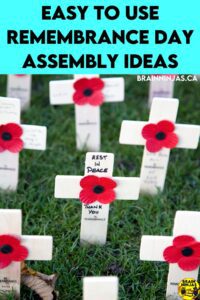
When you have speakers who are going to talk about the different aspects of Remembrance Day, they can prerecord their speeches as an audio or video recording. This works great for students that are nervous about public speaking.
If you’re looking for something a bit different than a speech, we use our Remembrance Day Drama Circle, which can be found in our TpT Store ($USD) or BN Shop ($CAN). We stand in a giant circle in the gymnasium and pass a microphone. For this circle we stand in the order of the cards so the microphone can just be passed down the line (which is a little different than how this would be performed in a classroom).
Live Performances Are Not Required
Presenters, speakers and singers do not have to perform live. Recordings can be a great workaround. Prepare these in advance and edit them down for time.
Our school is planning to go as low-tech as possible. Each recording will be in a single Google Drive. We will number each file. You can play them in order in place of an assembly.
We are planning to have all the performances in the morning leading up to the moment of silence, which will be held throughout the school at 11:00 a.m.
A Moment of Silence
Explain how and why the moment of silence is held during an assembly. It is important to remind everyone (including the adults who have come to attend the ceremony) that the expectation is silence. Teachers should review these expectations several times before the assesmbly.
If possible, remind the adults int he room that cell phones should be turned off for the entire assembly out of respect. Many adults bring young children. We always ask the adults that if the children cannot be quiet, please exit quickly out into the hall away from the doors.
Musicians Can Play
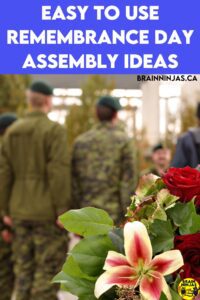
We are have one trumpet player play Taps for us at the end of the moment of silence. If you do not have a musician available, use a recording.
Change Up the Wreaths
If you can’t lay any kind of wreaths during a ceremony, try making a special display that students can view at some point during the week. This could be in a window, trophy case or designated display area. Teachers can walk their classes past the display to look at some point before or after the assembly.
Remembrance Day Ideas Before and After the Assembly
Get Online with a Soldier or Veteran
If you know someone in the Canadian Armed Forces, maybe your class can do an online interview? Maybe someone can speak to your class about the role of the armed forces or the duties of soldiers in Canada. There are many veterans who regularly connect with schools. Many will come to the school for interviews and to speak as guests.
Reach out to the Canadian Armed Forces using their webpage. If you send an email explaining your purpose, location and grade level of your students, you will often have your email forwarded along the chain of command until someone contacts you. This can take a while, so send your inquiry as soon as possible.
Once you’ve had a member involved with your school, you can use that same contact information. They will often need permission from the commanding officer, but it doesn’t take as long to go through the process.
Once you have a member, set up a date and time so they can interact with your students.
Art is for Remembrance Day
Your classrooms and hallways can be decorated with various works of art to honour past and current sacrifices. Photograph the artwork to share on your classroom or school website.
Over the years, we’ve done many different art projects and we’ve collected them together in this post called Simple and Stunning Remembrance Day Art Projects. And we have even more unique projects that go beyond the poppy in this post, How to Create Memorable Remembrance Day Art Projects.
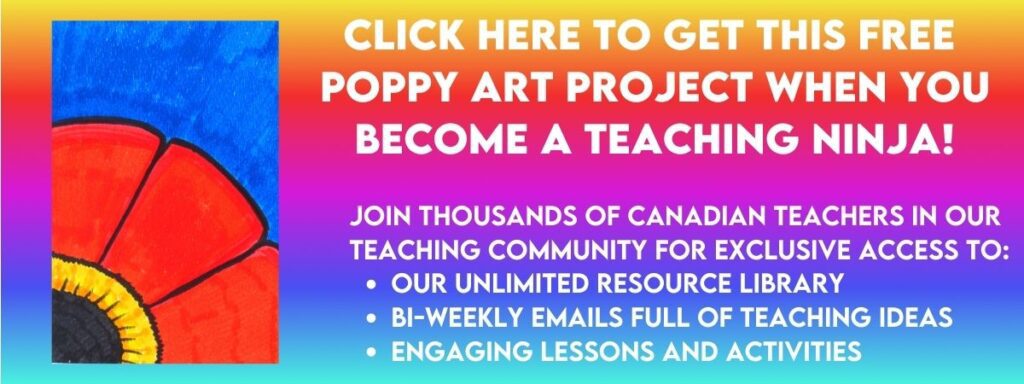
You can find a Poppy Art Lesson in our Resource Library, or we can email a copy to you when you join our mailing list to become a teaching ninja. We also have a watercolour poppy painting project that you can find for free in our TpT Store and BN Shop. There are even more projects in the Resource Library.
Another more structured way to include art is with a collaborative poster. Our Remembrance Day Collaborative Poster includes information about the history and symbols of Remembrance Day. Find it in our TpT Store ($USD) or BN Shop ($CAN) or the French Version in our TpT Store ($USD) or BN Shop ($CAN). We also have a National Indigenous Veterans Day Collaborative Poster in our TpT Store ($USD) or BN Shop ($CAN) or the French Version in our TpT Store ($USD) or BN Shop ($CAN).
Both posters can be found as part of the Remembrance Day Bundle in our TpT Store ($USD) and BN Shop ($CAN).
We have a very different poster that hangs horizontally. It features the poem For the Fallen. Find it in our TpT Store ($USD) or our BN Shop ($CAN).
Teach Your Students About Canadian War History
The lives of Canadians are and have always been changed by war. There was a time when Indigenous People were not able to serve in the Canadian Armed Forces. During the Second World War, Japanese Canadians were placed in internment camps.
There are definitely times in Canada’s past when mistakes were made. It’s important to teach students the good and the bad of war so they can understand the complexities as they grow up.
We wrote a series of short reading passages that examine how the lives of Ukrainians, Indigenous People, Indo-Canadians, women, children, and Chinese Canadians were impacted as a result of some of the different conflicts in Canadian history. Each passage comes in a different format: a letter, a diary entry, a personnel file, a narrative piece and an expository passage.
Canadians in War is the perfect activity to do in the days leading up to Remembrance Day, but due to the seriousness of the content, you’ll need to use it with upper elementary students. It is not a subject that should be rushed, but it’s worth the time. Find it in our TpT Store ($USD) and BN Shop ($CAN). It is also part of the Remembrance Day Bundle in our TpT Store ($USD) and BN Shop ($CAN). Best of all, you can use it any time of year in your social studies lessons.
We have created a collaborative poster activity to learn about National Indigenous Veterans Day. Students will learn a little about the history of the day and how Indigenous People from Canada served during different conflicts. Find this activity in our TpT Store ($USD) or BN Shop ($CAN). Learn more in our post How to Honour National Indigenous Veterans Day.
Read to Your Students
We’ve gathered a list of books that make great reads any time of year but have a theme perfect for Remembrance Day. You can read the list by checking out our post: Memorable Books for Remembrance Day.
Sometimes, we’ll choose a novel a few weeks before Remembrance Day so that we can finish it right on time.
Write to a Member of the Canadian Armed Forces
Military personnel serve Canada year-round. This often means long periods away from their family and friends. Your students can write letters of support or friendship to members.
When you write the letters, there are some restrictions about what can and cannot be included. Read the guidelines before you start this project. Since you will be writing to “any Canadian Armed Forces Member,” go down to the instructions. These letters are not free to send. You will have to pay for postage. Send them as bulk mail If your letters meet the requirements.
Write About Remembrance Day
We created a set of Remembrance Day Writing Prompts so our students could write and reflect every day for ten days. Use the prompts on paper or digitally, making it easy to use whether students are in your classroom or learning from home. Students don’t need to have lots of background information to write about Remembrance Day. Find them in our TpT Store ($USD) or BN Shop ($CAN).
Walk the Walk
Each year we reflect during that moment of silence. We think about the sacrifices and losses. We might even think about individuals we have known.
This year, more than ever, we need to remember what it means to be Canadian. Canadians have a long history of standing up for people. We also have darker moments where mistakes have been made. Teach both sides of each story.
Everyone needs to stand up against wrongs. We need to teach our students how to fight against inequality because as much as we’d like to believe the war is over, it is very much still something we need to fight for each and every day.
Let us know how your Remembrance Day assembly ideas. Tell us about it in the comments below.
Frequently Asked Questions
Are Remembrance Day assemblies required in Canadian schools?
Yes, in many provinces. In Alberta, it is written into the School Act as a requirement, and schools must hold a Remembrance Day assembly on the school day closest to November 11.
Do assembly performances have to be live?
No. Speeches, singing and musical performances can all be prerecorded as audio or video ahead of time. This works well for students who are nervous about public speaking and helps assemblies run smoothly.
What happens during the moment of silence?
Schools typically hold the moment of silence at 11:00 a.m. Teachers should review expectations for silence with students (and remind visiting adults) several times before the assembly.
What art projects work well for Remembrance Day?
Popular options include a free poppy art lesson, a watercolour poppy painting project, and collaborative posters on Remembrance Day history and symbols, the poem “For the Fallen,” and National Indigenous Veterans Day.
What resources teach older students about Canadian war history?
Canadians in War is a set of short reading passages (letters, diary entries, personnel files, narrative and expository pieces) exploring how Ukrainians, Indigenous People, Indo-Canadians, women, children and Chinese Canadians were affected by conflict. It is best suited for upper elementary students.
Can students write to members of the Canadian Armed Forces?
Yes. Students can write letters of support or friendship to “any Canadian Armed Forces Member.” There are guidelines about what can be included, and letters must be sent as bulk mail with postage paid.
Looking for More Remembrance Day Posts?
- How to Create Memorable Remembrance Day Art Projects
- Simple and Stunning Remembrance Day Art Projects
- Memorable Books for Remembrance Day in Canada
- How to Teach the Importance of Remembrance Day
- Remembrance Day Resources for Canadian Classrooms
- How to Honour National Indigenous Veterans Day