You’ve taught patterns before. You know the routine. You explain repeating patterns, growing patterns, equations with variables, and your students nod along. But then you ask them to work independently, and something’s missing. They don’t remember what you just showed them. They can’t visualize the concept when it’s on paper. And when you ask them to explain their thinking, they’re stuck.
Here’s the thing about patterns and algebra in elementary: it’s abstract. Variables are abstract. Pattern rules are abstract. Equations are abstract. Our students struggle with abstract. What they need is something concrete, something visual, something they can hold onto and reference whenever they’re confused.
But we figured out the game-changer.
The Power of a Hand-Built Reference Page
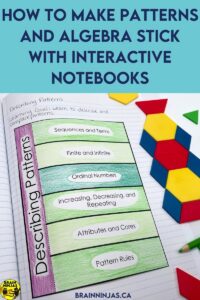
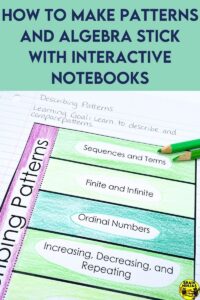
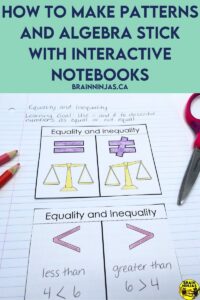
Here’s what makes interactive notebooks different from a worksheet. When students create a notebook page by hand, they’re not just taking notes. They’re processing the information and deciding what matters. They’re putting patterns into their own words and drawing the concept. And when they’re done, they have a visual reference they created themselves.
We built the Patterns and Algebra Interactive Notebook Unit (available for Grades 3, 4, 5, and 6) specifically because we kept hearing the same complaint from teachers: “My students learn the concept in the lesson, but they can’t apply it independently. They don’t have anything to refer back to when they’re stuck.”
That active, hands-on process of building the page is the learning. The finished page is proof that it stuck.
Research on note-taking backs this up. Students who handwrite notes and create visual representations remember more, understand deeper, and can apply the concept to new situations. Because they built it, they own it.
When students return to their reference page during practice, they’re not just copying an answer. They’re reinforcing the concept. They’re connecting new problems to old understanding. Each time they flip back to their notebook, they strengthen that neural pathway. That’s retention. That’s transfer of learning to new situations.
Everything You Need, Ready to Go
We put together this unit because we know you don’t have time to create 15 different lessons, hunt for practice activities, and build a complete assessment. You’re already doing too much.
The Patterns and Algebra Interactive Notebook Unit includes everything: lesson plans with all the concepts broken down, student template pages (some require cutting and gluing, and we also included a no-cut version so you’re not spending prep time with scissors), practice worksheets, proof questions for quick checks, games and activities, and differentiated unit assessments. You get curriculum alignment guides for Canadian provinces so you know exactly which lessons match your specific curriculum.
It’s designed as a complete unit. You work through it from start to finish, your students build their reference pages along the way, and by the end, they have a notebook they can study from before any assessment.
One teacher told us: “I love how this unit comes with a mix of everything I needed for a math unit: whole-class lessons, differentiated practice, and assessments.” Another said: “This interactive notebook made taking notes so much more meaningful for my students!” That’s what happens when you take reference pages seriously.
The No-Cut Version Changes Everything
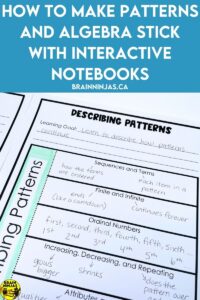
Let’s be honest: cutting and gluing takes forever. If you’re worried about prep time or about students with fine-motor challenges burning out before they even get to the learning, we hear you.
That’s why we included a no-cut version. Print it. Students write directly on the page. Same learning, way less time wasted on scissors and glue. You choose which version works for your class. You can even get your whole year printed and bound at the beginning and then just use the book all year.
Grades 3 Through 6 All Covered
We built versions for Grade 3, Grade 4, Grade 5, and Grade 6. The core concept is the same across all levels: students build reference pages as they learn patterns and algebra, then return to those pages during practice and assessment. The content gets more complex as grades go up, but the approach stays the same.
If you teach multiple grades, you can use the same framework across your grade team.
What Teachers Get Back: Planning Time
The secondary benefit here isn’t just what students gain. It’s what you get back: planning time. You don’t have to spend hours creating different activities for students at different levels or hunt for practice pages that align to your curriculum. You don’t build unit tests from scratch. It’s all done.
That matters. Because when you buy planning time back, you can actually teach. You can watch your students work and adjust on the fly. It gives you the chance to ask better questions. You can notice who’s confused and jump in before they give up.
How to Use This for Your Patterns and Algebra Unit
Introduce one concept at a time. Model the notebook page on a document camera so students see exactly what you’re doing. They build their page while you build yours. Once the reference page is done, students move to practice activities and games. They return to their reference page whenever they need to. After you’ve taught all the concepts and students have built their whole notebook, they use it to study for the assessment.
That’s it. That’s the unit.
By the end, your students don’t just know patterns and algebra. They have proof they know it. They have a reference tool they built and own. And they can explain their thinking because they can point to their own notebook page and say, “I did this, so I know this.”
Ready to Give Your Students a Reference They’ll Actually Use?
Don’t reinvent the wheel. We’ve already built the entire unit for you. Find the Patterns and Algebra Interactive Notebook Unit for your grade level and let your students build the reference pages that will anchor their understanding all year long.
Grade 3 in our our BN Shop ($CAD) or on TpT ($USD).
Grade 4 in our BN Shop ($CAD) or on TpT ($USD).
Find Grade 4/5 in our our BN Shop ($CAD) or on TpT ($USD). This is designed for combined grade classrooms.
Grade 5 in our BN Shop ($CAN) or on TpT ($USD).
Grade 5/6 in our our BN Shop ($CAD) or on TpT ($USD). This is designed for combined grade classrooms.
Find Grade 6 in our our BN Shop ($CAD) or on TpT ($USD).
Your planning time is waiting. Your students’ confidence in patterns and algebra is waiting. We’ve done all the planning for you so the only thing left to do it teach.
People Also Ask
- Why is it important to teach patterns in elementary school? Answer: Patterns develop algebraic thinking, which is foundational for middle and high school algebra.
- What makes interactive notebooks effective for math? Answer: The hands-on process of creating pages strengthens memory, aids understanding, and gives students a reference tool they built themselves.
- How do you teach algebra to elementary students? Answer: Start with concrete patterns, move to visual representations, introduce variables gradually, and build reference pages students can use repeatedly.
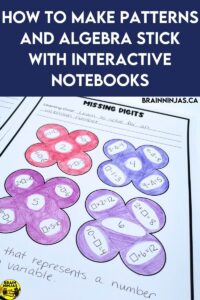
- What’s the best way to teach expressions and variables? Answer: Use hands-on activities, manipulatives, and real-world contexts. Have students build pages that show what variables mean.
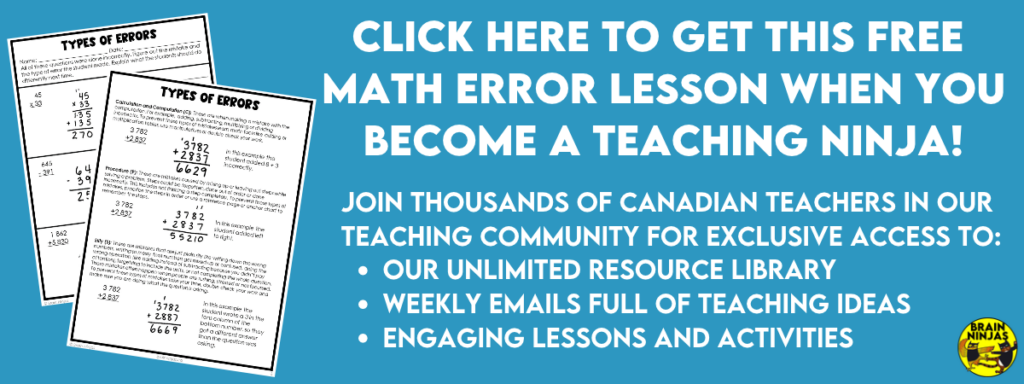
You can also teach students to use their interactive notebook pages to find errors on worksheets they’ve done. Use this Error Analysis Lesson to help students analyze different mistakes so they can show their understanding and fix their own mistakes.
Generic interactive notebook templates exist out there, but most aren’t subject-specific, teacher-modeled, or Canadian-aligned. Custom-built units online range widely in quality and completeness. Most don’t include no-cut options or differentiated assessments. Our unit stands out because it’s curriculum-aligned, complete, print-ready, and designed by teachers who understand elementary math specifically.
Read more:
How to Change Math With Interactive Notebooks
How to Use Interactive Notebooks to Teach Number Sense
We’d love to hear about your experiences using our interactive math notebooks.



Leave a Reply