Teaching is stressful. It can be exhausting for everyone in the classroom. Sometimes you just need to break the tension with a silly game.
We use silly games strategically. They are not just randomly thrown into the day. The games we’ve included are very simple and can be modified for any of your needs. Read about the different silly classroom games we use in our classroom and how we use them to help strengthen our students mentally and physically.
Regulate Emotions With Classroom Games
First of all, we use classroom games to help students learn to regulate their emotions. So many students are having trouble with taking turns, being patient, calming and being a part of a society that doesn’t revolve directly around them.
Some people refer to these games as brain breaks and while that can be a reason, we have information in this post about how we use brain breaks (and how we don’t). All the games mentioned in this post can be used as brain breaks, but we use them a little differently.
All of the games in this post are screen-free and require minimal equipment so you don’t need to spend a lot of time or money to play.
Streamline Transitions
We work very hard with our students to make sure transitions are quick and efficient.
Before a transition starts, we have already made indications about when and how we will be switching activities. We do this by writing a note with the time of the transistion on the board a few minutes before the switch. We also include information about where the materials we are currently using will go and which materials we will need for the next activity will be found (if students don’t already have them).
Students learn quickly that if they transistion quickly and efficiently, they might get rewarded with a quick game before we start. We keep this completely random so students don’t become complacent.
When we start the transistion, students that are ready can begin the game with us. Sometimes this means other students don’t get to play at all (because they are taking too long) or we limit the game to a few students who are ready to work as a reward.
You can add a countdown. For example, if students can be ready in two minutes, they can use the other three minutes of the transition for the game. But, if they aren’t ready, there may not be enough time to play.
Build Relationships and Learn How to Act Like a Human
Being silly and playing games helps build relationships between yourself and your students. This doesn’t mean you need to be playing games every moment of every day. It just means that students need to see you in a light that makes you a human. It can be a great way to release a bit of tension-especially for those students that are getting on your nerves. It’s hard to be annoyed at people when you’ve had a bit of fun together.
This also works between students. They learn to work together (or compete in a healthy way).
Some students need work just learning how to interact with others and classroom games are a great way to help them learn those social skills.
Teach Turn-Taking, Patience and Sportsmanship
So many of our students play video games where they aren’t required to wait their turn. Video games today aren’t at all like the ones we played when we were younger. We would spend time working our way up the levels only to lose that last life and have to start all over. Now with cheats, multiple saves, entire channels dedicated to showing people how to level-up in minutes, few students have the patience to work through multiple challenges in a row.
Students find it hard to wait until it’s their turn. They don’t know how to deal with loss and failure because it’s not something they experience enough. Maybe it’s my jaded Gen X upbringing, but we’ve swung the pendalum a bit far by not allowing students to experience failures when they are young enough to be learn to be resilient. It needs to be a balance of not winning and winning so students can learn how to deal with both.
Control the Classroom Energy
Sometimes when the mood of the classroom is dreary and tired, a quick game can help boost energy and get students ready for learning again.
In the winter, when we are often inside WAY too much, we like to break out a game here and there. It can be completely random or when we’re just feeling like the energy is drained. Use classroom games as a quick pick up for the energy.
Buy hey, if your class is already climbing the walls with too much energy, a quick calming game can help get students calm and ready to work.
Have You Tried These Classroom Games?
Cup Balancing
- Equipment: one plastic cup per student (or something else to balance on student heads)
- Time: A few minutes until you decide to end the game.
- Goal: Slowing down, deep breathing or calming the classroom.
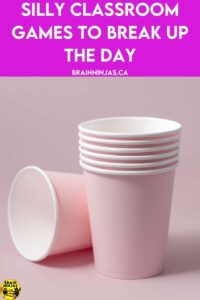
Everyone stands with a cup balanced on their head. Last cup standing wins. You can make this more challenging by asking students to walk, sit in a chair or trade places with another student. We encourage no talking. When students drop, then sit down where they are.
Pick It Up
- Equipment: one plastic cup per student (or something else that can tip to balance on student hands)
- Time: A few minutes until you decide to end the game.
- Goal: Slowing down to be intentional. This can also be used to liven a class up.
Everyone wears a cup with the narrow side down on their hand (you can use to back of the hand or the palm). The task is to pick up something from the floor without dropping the cup. Depending on the amount of time we have we may give students more than one attempt. Make this more challenging as the year progressed by picking up smaller objects, using tippier cups or putting a time limit on picking up the object.
Grab the Cone
- Equipment: a whistle (or something to indicate-we blink the lights to avoid extra noise), a cup or small pylon per two students in partners. If you have an unever number, a group of three can make a triangle.
- Time: A few minutes until you decide to end the game.
- Goal: Boost energy and let students test their reflexes.
Students sit across from each other in a V shape and place the bottoms of the feet against each other. Put a cup or cone in the middle between the two students. Students sit with their hands behind their backs on flat on the floor behind themselves. When the sound indicates, the first student to grab the cone wins.
You can play to a best of 3, 5 or 7. Put the winners together to play against each other and the “losers” can play against each other too.
Partner Pairings
- Equipment: large space to move around, music (optional)
- Time: A few minutes until you decide to end the game.
- Goal: Working with others, movement, boosting energy
Students will move around the space. We put on music. When the music stops, we call out one of these and students move. We don’t use all of these the first time (and depending on your students you may not want to use all of them). Teach 3-5 per session until you have a whole collection. You can also ask students to invent more pairings to personalize your game.
If you have an uneven number, you can have one student be the caller. Trade the student out every few calls.
- Pretzel: Students link arms with a partner. One makes an O shape and the partner makes another O but links through the first one.
- Lover’s Leap: One partner jumps into the arms of a classmate who lifts them up.
- Chicken in a Hen House: One partner gets down on all fours and the partner kneels on their back.
- Bird in a Birdcage: One partner kneels down with one knee up. Another partner sits on their knee and flaps their wings.
- Dog in a Doghouse: One partner lies on the floor. The partner does a downward facing dog bend over them.
- Bookshelf: One partner gets a piggyback from a partner and they put their arms straight out like they are flying.
- Chicken Noodle Soup: One person puts their arms out in a circle in front to them. The partner stands in the circle and spins with their hands up high in the air.
- Bunk Bed: On partner lies on the floor with their arms out in front. The partner puts their ankles in the other partners hands and then balances on the partners ankles.
- London Bridge: Two partners stand facing each other and put the hands pointing upwards to make a bridge.
- Back pack: Partners stand back to back linking arms. One partner gently lifts the other partner off the ground so they are leaning on the first partner’s back.
- Airplane: One person stands on one foot with the back foot straight out. The partner holds their ankles.
Don’t Lose Your Marbles
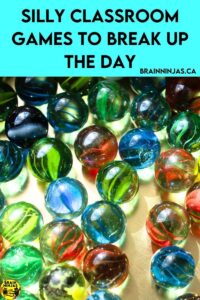
- Equipment: paper plates with a hole cut in the centre, marbles
- Time: 2-5 minutes or until all the marbles drop
- Goal: calming, balance, teamwork
Put students into a circle. Place three marbles on a paper plate (the flimiser the plate is, the better). Hand the plate to a student. Students can only use one hand. to pass the plate along the circle. The goal is to pass the plate without dropping the marbles. Make it more interesting by adding multiple plates to the circle.
One year our class added a challenge. Each marble represented one minute of “free time” so they would try to keep as many marbles as possible. We would add a few plates worth and sometimes extra marbles. We found the more marbles and plates, the more dropped because it was more difficult, but students worked really well to try to earn those marbles.
Pylon Pass
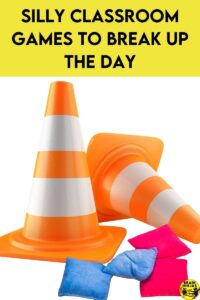
- Equipment: pylons (or buckets/grocery bags), large space, bean bags or soft balls
- Time: A few minutes until you decide to end the game.
- Goal: teamwork, movement
Divide your class in half. Make each half stand facing each other. One side of the group will hold pylons upside down (like a bucket) and the other side will have the throwing objects. Our students throw bean bags, but any small, soft ball will work.
Students will toss the objects to their partner who will try to catch it in the pylon. If it is successfully caught, both partners take a step apart which will increase the throwing distance. If the object is dropped, both partners take a step toward each other. Return the object to the thrower and repeat until you run out of space or time.
You can also play this with a bucket, stocking or a grocery bag.
We changed this up by only have one pylon on each side, so students had to coordinate the thrower and the catcher (almost like they are playing in teams).
Cup and Cane
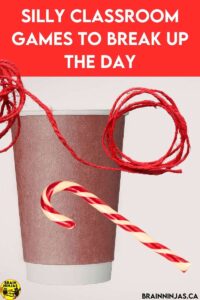
- Equipment: a cup, string, and hooked object (like a candy cane)
- Time: A few minutes until you decide to end the game.
- Goal: teamwork, energy boosting, problem-solving
Place a cup on the floor in the middle of a small group. Place an object that can be hooked (like a candy cane) on the floor next to the cup. Give each group a section of string about a metre long. They must pick up the object and place it in the cup only using the string. They cannot touch the object or the cup with their hands or feet.
Our students figured out they need to get the string somehow tied to the object before they could try to lift it. One group managed to get the hook looped onto the string and then worked together to lift it into the cup.
Switcharoo
- Equipment: None
- Time: A few minutes until you decide to end the game.
- Goal: energy boosting
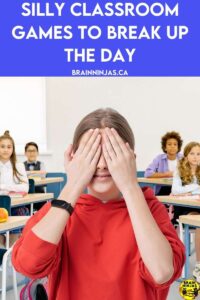
Choose one student. They stand with their back to the class and cover their eyes. Send one student out to the hall. The rest of the students stand and rearrange themselves so they are sitting in a different chair.
Have the student turn around and try to guess who is missing from the classroom.
You could limit the number of guesses to make it more challenging. For example, our students got two guesses. If they still didn’t get it right, we had the student turn around and then we shuffled and removed a second student. If they still didn’t get it right, we started over.
It was much more difficult for students at the beginning of the year when they didn’t know each others’ names as well.
Would You Rather?
- Equipment: None (but we use these free questions)
- Time: A few minutes until you decide to end the game.
- Goal: building relationships, communication skills
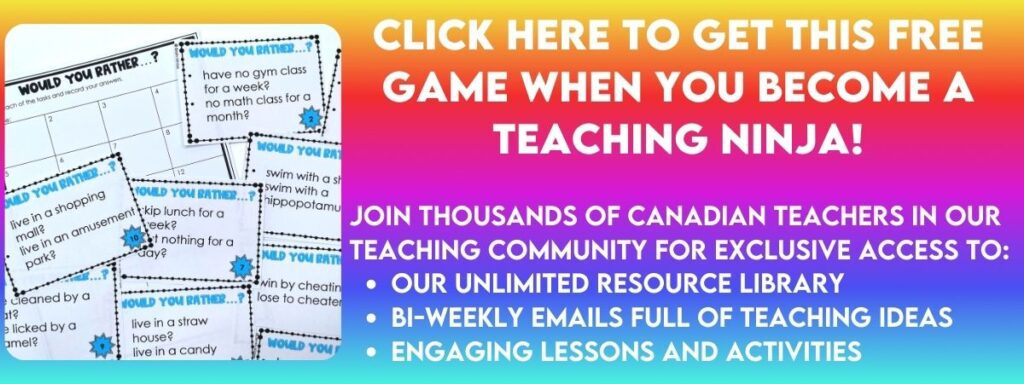
Our students love to make up questions for a game where they ask classmates what they would rather do, eat, play, see or feel. We have already created a simple version of this game. We’ll send it to your inbox when you sign up for our email list. If you’re already a ninja, you can find the game in the Resource Library.
Looking for More Ideas for Classroom Games?
- Are You Still Wasting Time With Brain Breaks?
- 13 Ways to Deal With Behaviours Without Taking Away Recess
- Quiet Classroom Games You’ll Love
What are some of your favourite silly classroom games? We’d love to add them to the post. Leave us a comment below.




Leave a Reply